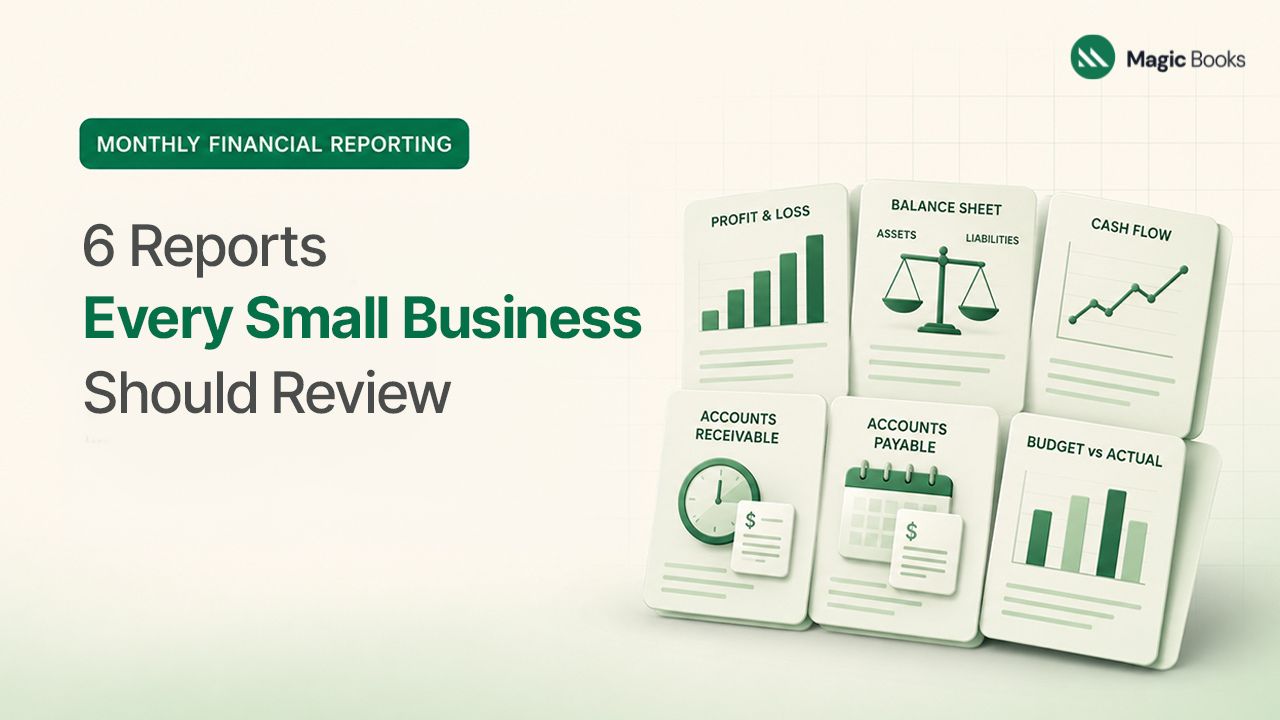
Most small business owners only look hard at their financials twice a year: once at tax time, and once when something goes wrong. That’s a shame, because the numbers that matter most are the ones you check regularly, not the ones you scramble to pull together in April. A handful of reports, reviewed every month, can tell you almost everything about how the business is actually doing right now, not six months ago. Some owners keep their own books; others lean on a bookkeeper or a service like Magic Books to keep the numbers current so the reports mean something the moment they’re pulled. Either way, the real question isn’t whether you’re profitable on paper. It’s whether you understand what these six reports are telling you, and whether you’re looking at them often enough to act on what you find.
The Profit and Loss Statement: what your margins are actually telling you
The P&L, also called the income statement, is probably the report most owners already glance at. It lists revenue, subtracts your costs, and lands on a bottom-line profit or loss for the period. Simple enough on the surface.
Where it gets useful is when you stop looking at the bottom line and start looking at the shape of it. Is revenue growing while margin shrinks? That usually means costs are creeping up faster than sales, and it’s worth knowing before it becomes a habit rather than a blip. A monthly P&L catches that shift while there’s still time to do something about it. Wait for the annual version and you’re diagnosing a trend that’s already a year old.
A bakery owner notices ingredient costs eating into margin for two months running, and switches suppliers before it becomes six months and a real dent in annual profit. That’s a decision a quarterly or annual report would have caught too late to matter.
Keeping this report accurate every month depends on closing your books cleanly, categorizing expenses consistently, and not letting entries pile up. If that part of the process feels shaky, a Month-End Close Checklist for Small Businesses walks through what a clean close actually involves.
The Balance Sheet: a snapshot of where the business stands
If the P&L is a video of the last month, the balance sheet is a photograph taken the moment you print it. It shows what the business owns, what it owes, and what’s left over at that exact point in time.
Owners tend to underuse this one, maybe because it doesn’t have the drama of a profit number. But it answers a different, equally important question: even if last month looked good on paper, is the underlying business getting stronger or weaker? A business can be profitable every month and still be piling up debt or draining its cash reserves if nobody’s watching the balance sheet alongside the P&L.
An owner sees short-term liabilities creeping up relative to assets over a few months and decides to slow down a planned equipment purchase rather than stretch the business thin. Reviewing this monthly, instead of once a year, is what makes that kind of early course correction possible.
Solid balance sheet numbers also depend on the internal habits behind them: how invoices get recorded, how petty cash gets tracked, who can approve a purchase. A Financial Controls Every Small Business Should Implement guide covers the basics worth putting in place, especially as a business grows past the point where one person can eyeball everything.
The Cash Flow Statement: why profit on paper isn’t cash in the bank
This is the report that trips up more small businesses than any other, and it’s the one owners most need to check monthly rather than quarterly.
Profit and cash are not the same thing. A business can show a healthy profit on the P&L and still run out of cash to make payroll, usually because money is tied up in unpaid invoices, inventory, or loan payments that don’t show up as expenses the same way. The cash flow statement tracks money actually moving in and out, which is a very different picture from money earned on paper.
This gap matters most for businesses with seasonal swings or long payment cycles, where a strong month on the P&L doesn’t guarantee cash on hand when rent is due. A piece on Can My Business Survive a Slow Season? digs into how owners plan around exactly this kind of mismatch.
A landscaping company profitable every summer but cash-strapped every winter uses monthly cash flow tracking to build a reserve during the good months instead of scrambling for a line of credit when things slow down.
This is also where the reporting workload tends to pile up on an owner’s plate. Between reconciling accounts, chasing down cash timing, and keeping the numbers current enough to actually trust, it’s a lot to manage alongside running the business itself. That’s the gap bookkeeping services exist to close, and for owners who want someone reading these numbers strategically rather than just recording them, CFO services take it a step further by turning the monthly reports into an actual plan.
Accounts Receivable Aging Report: who owes you money and how late they are
The AR aging report breaks down every outstanding invoice by how long it’s been unpaid, usually in buckets like current, 30 days, 60 days, and 90-plus. It turns “we’re owed money” into “here’s exactly who owes it and how worried we should be.”
Checking this monthly instead of when it becomes a problem is what lets an owner catch a slow-paying client before that invoice slides from mildly late to written off. It also flags patterns. If the same three clients are always in the 60-day bucket, that’s less a coincidence and more a signal that a business needs to firm up its payment terms or start collecting deposits upfront.
A consulting firm notices a client sliding into the 90-day bucket for the second quarter in a row and decides to pause new project work for that client until the balance clears, protecting cash flow rather than compounding the risk.
Letting invoices age unchecked for too long is one of the quieter ways a business’s books drift out of control. If that’s already happened, What Happens If Your Bookkeeping Is a Year Behind lays out what it actually takes to catch up.
Accounts Payable Aging Report: what you owe and when it’s due
The mirror image of the AR report, this one lists what the business owes to vendors, suppliers, and lenders, and when each payment is due. It’s easy to overlook because unpaid bills feel less urgent than unpaid invoices coming in, but ignoring this report is how businesses end up with damaged supplier relationships or late fees that were entirely avoidable.
A monthly look at AP aging lets an owner plan payments around cash flow instead of reacting to whichever bill lands first. It also surfaces early warning signs, like relying on stretching out payments to vendors simply to cover a cash shortfall elsewhere, which is a pattern worth catching before it becomes the norm.
An owner sees three separate vendor payments due in the same week and negotiates a slightly staggered schedule with one supplier in advance, rather than scrambling for cash or missing a payment altogether.
Budget vs. Actual Report: checking the plan against reality
Most small businesses build some kind of budget at the start of the year and then never look at it again until the next one gets built. The budget vs. actual report is what closes that loop. It lines up what you planned to spend and earn against what actually happened, category by category.
Reviewed monthly, it catches drift early. A marketing line item that’s 40 percent over budget by March is a manageable conversation. The same overage discovered in December, after eleven months of spending, is a much harder one.
An owner spots that software subscriptions are running well above what was budgeted, checks which tools are actually still in use, and cancels three the team stopped using months earlier.
This is also where DIY bookkeeping tends to fall short. An owner can usually do the math fine; staying disciplined about monthly comparisons is the part that takes time most owners simply don’t have. A DIY Bookkeeping vs Professional Service: The Real Cost Comparison piece breaks down what that time tradeoff actually looks like in practice.
Making decisions with facts instead of guesswork
None of these six reports is complicated on its own. What makes them useful is looking at them together, every month, instead of scattered and after the fact. The P&L tells you if you’re making money. The balance sheet tells you if the business is getting stronger. Cash flow tells you if you can actually pay your bills. The aging reports tell you who owes what and who’s owed. Budget vs. actual tells you whether the plan you made still holds up against what’s really happening.
Put together, monthly reporting is really just a habit of making decisions with facts instead of guesswork. That’s the whole point. An owner who checks these numbers every month catches problems while they’re still small and cheap to fix, instead of discovering them at tax time when the year is already gone.
If keeping up with all of this feels like more than you have time for, that’s exactly the kind of thing Magic Books helps small business owners stay on top of, month after month, without adding it to an already full plate.