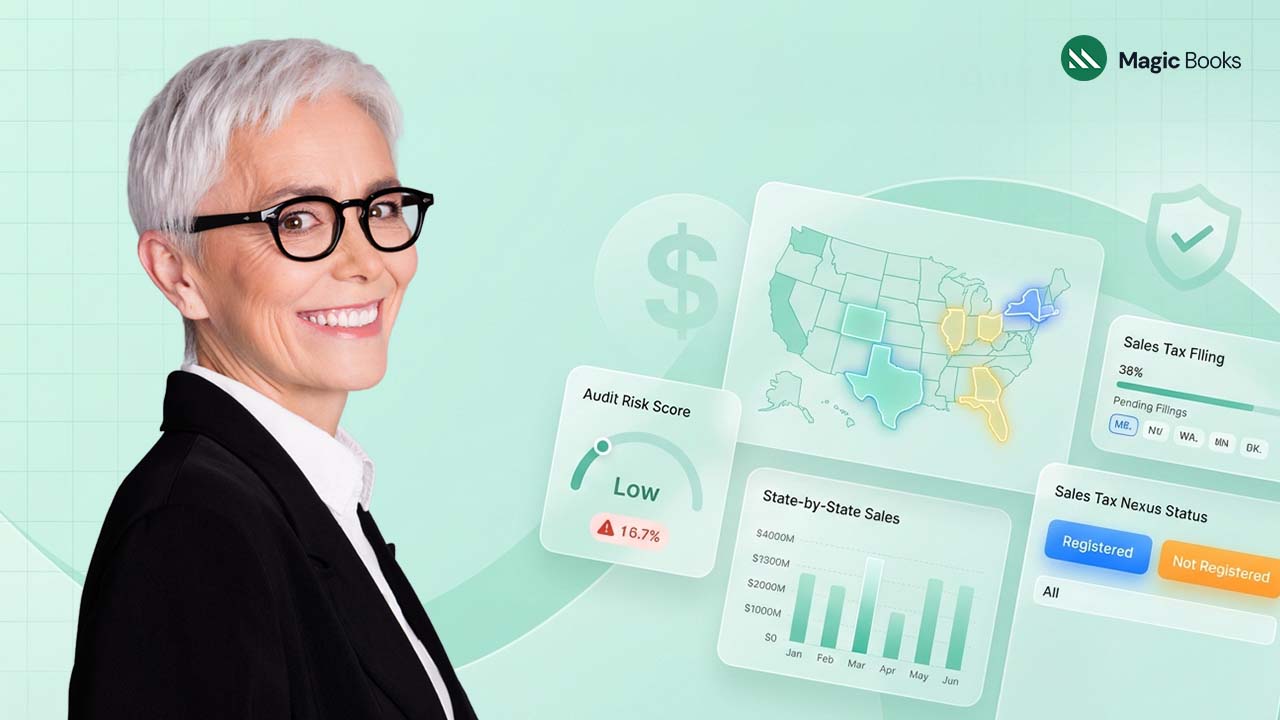
According to the Sales Tax Institute, every state in the U.S. that has a sales tax now has economic nexus rules that can require remote sellers to register, collect, and remit sales tax. According to the U.S. Census Bureau, e-commerce sales added up to $304.2 billion in the second quarter of 2025, accounting for 16.3 percent of total U.S. retail sales. These statistics illustrate why sales tax compliance is fast becoming a pressing concern for sellers who operate across state lines. Multistate and online sellers can be audited, assessed penalties, and be liable if they do not fulfill their nexus obligations and collect sales tax appropriately.
What Is Sales Tax Nexus And Why Wayfair Changed Everything
Nexus is the tax connection between a seller and a state that triggers the obligation to collect and remit sales tax. Before 2018, sellers needed a physical presence (such as employees, offices, or warehouses) in a state to create nexus. The Supreme Court decision in South Dakota v. Wayfair overturned that physical presence requirement and allowed states to impose tax collection duties based on economic activity alone. This ruling recognized that modern e-commerce does not align with tests that rely on physical presence and that requiring physical locations created artificial competitive advantages for remote sellers.
Since Wayfair, states have rapidly adopted economic nexus statutes that measure seller activity by dollar sales or transaction counts rather than physical location. The decision fundamentally shifted sales tax compliance from a concern primarily for brick-and-mortar retailers to a universal requirement for any business with substantial sales into a state.
How States Set Economic Nexus: Thresholds And Tests
Most states trigger economic nexus using one of two measures: total dollar sales into the state or the number of separate transactions. The most common threshold is $100,000 in annual sales, though some states also include a 200-transaction count. As of mid-2025, 15 states have eliminated their transaction-count thresholds entirely, including South Dakota, California, Colorado, Indiana, Iowa, Louisiana, Maine, Massachusetts, North Carolina, North Dakota, Utah, Washington, Wisconsin, and Wyoming, according to Avalara research.
Illinois will remove its transaction threshold on January 1, 2026. States measure these thresholds over different evaluation periods (current calendar year, previous calendar year, or rolling 12 months), and they define what counts toward the threshold differently (some include exempt sales, others do not). Thresholds and rules change frequently as state legislatures adjust tax policy. Financial professionals should check state Department of Revenue pages or centralized trackers such as the Tax Foundation’s economic nexus guide or the Sales Tax Institute’s state-by-state chart at least quarterly to confirm current requirements.
Marketplace Facilitator Rules
A marketplace facilitator is a platform that lists products or services for sale on behalf of third-party sellers and processes payment or fulfillment for those sales. Examples include Amazon, eBay, Etsy, and Walmart Marketplace. All states with sales tax have enacted marketplace facilitator laws requiring these platforms to collect and remit sales tax on behalf of their sellers. The facilitator assumes the collection and remittance obligation even when the underlying seller would otherwise meet nexus independently.
Marketplace facilitator statutes generally apply when the platform exceeds the state’s economic nexus threshold (typically $100,000 in sales). Once a facilitator is collecting tax, the individual seller does not need to collect tax on those same sales again, though the seller may still need to register and report marketplace sales in some states. States enacted these laws to simplify compliance and close revenue gaps, and Avalara’s marketplace facilitator guide provides state-specific effective dates and requirements. Some states, including Texas and Wisconsin, require facilitators to notify sellers that they will collect tax on the sellers’ behalf.
Registering, Collecting, Filing, And Remitting
A multistate seller must first determine where it has nexus by reviewing its sales and transaction activity in each state against that state’s thresholds. Once nexus is established, the seller must register with the state’s tax authority, obtain a sales tax permit or license, and begin collecting tax on taxable sales delivered into that state. Registration typically requires basic business information, Federal Employer Identification Number, and details about the seller’s anticipated sales volume.
The collection requires determining the correct rate for each transaction. Most states use destination-based sourcing, meaning the seller must charge the combined state, county, city, and district tax rate at the customer’s delivery address. A minority of states (including Arizona, Illinois, Mississippi, Missouri, Ohio, Pennsylvania, Tennessee, Texas, Utah, and Virginia) use origin-based sourcing for intrastate sales, where the seller charges the rate at its own location. Sellers must also determine product taxability, as states vary widely on whether clothing, groceries, digital goods, software, and services are taxable. Avalara’s state rate tool and state Department of Revenue taxability matrices are essential resources for accurate rate and taxability lookups.
Once tax is collected, the seller must file returns (monthly, quarterly, or annually depending on volume) and remit the payments by the state’s due date. Late filing or late payment triggers penalties and interest, which vary by state. Sellers must also maintain detailed records of all sales, including customer location, amount charged, tax collected, exempt sales supported by valid exemption certificates, and filing confirmation. Most states require records to be kept for three to four years, though some specify longer retention periods.
Sales Tax Automation And When To Use It
Manual sales tax compliance becomes impractical once a seller has nexus in more than a few states. Tax automation software connects to a seller’s e-commerce platform, point-of-sale system, or accounting software and performs rate lookup, tax calculation, exemption certificate management, return preparation, and filing calendar tracking. Automation reduces error risk and frees accounting staff from repetitive data entry.
Automation is particularly valuable for businesses with high transaction volumes, diverse product catalogs, or sales into many jurisdictions. According to compliance research, sellers who rely on manual processes face higher audit rates and penalty assessments. The Census Bureau’s data showing e-commerce now represents more than 16 percent of total retail sales underscores the scale of cross-border transactions that require automated compliance support. Sellers should evaluate automation when they establish nexus in five or more states or when compliance tasks exceed 10 hours per month.
Audit Triggers, Penalties, And Common Pitfalls
State tax authorities audit sellers for multiple reasons. Common red flags include late or inconsistent registration, underreported sales compared to third-party data sources (such as credit card processors or marketplace reports), incorrect product taxability classification, failure to collect tax on shipping or handling charges, and missing or incomplete exemption certificates. Another frequent trigger is a seller that meets nexus but relies entirely on marketplace facilitator collection without understanding that some states still require seller registration.
Penalties vary by state but typically include late filing penalties (a percentage of tax due or a flat fee per return), late payment penalties (a percentage of unpaid tax per month), and interest on unpaid balances. Some states impose additional penalties for negligence or fraud. The Tax Foundation’s research provides comparative penalty structures across states. Most states have a statute of limitations of three to four years from the filing date or due date, though this period extends if a seller fails to register or file at all. Sellers should keep records for at least three to seven years, depending on state-specific statutes, and should document nexus determinations, taxability research, and filing confirmations to reduce audit risk.
Keeping Up To Date And Useful Resources
Sales tax laws change constantly. States adjust thresholds, add new taxable categories, modify filing frequencies, and update exemption rules. Financial professionals must monitor state Department of Revenue websites, subscribe to tax authority newsletters, and consult reputable third-party resources. Essential resources include:
- Streamlined Sales Tax Governing Board for member state simplification initiatives and registration systems
- Sales Tax Institute economic nexus guide for state-by-state threshold tracking
- Tax Foundation’s state tax data for policy analysis and threshold updates
- Avalara’s tax changes tracker for rate, rule, and marketplace facilitator updates
- Individual state Department of Revenue sites for official guidance, forms, and taxability matrices
Set a quarterly calendar reminder to review nexus obligations and check for threshold or rule changes in states where your clients or firm has established nexus.